
ABC Leisure Group Limited
Registered in England, Company number 2860394
Registered address:
Alvechurch Marina
Scarfield Wharf
Alvechurch
Worcestershire
B48 7SQ

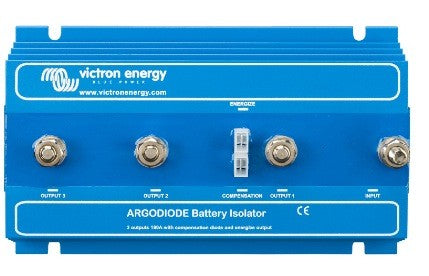
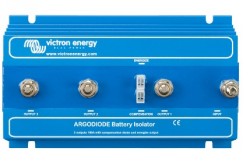
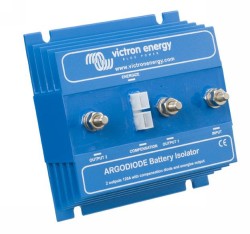
A Victron diode battery isolator lets one charging source charge several batteries at once while keeping each battery bank electrically separate. Think of it as a one-way valve for power. Current can flow from the charger to each battery, but it cannot flow back the other way. This helps stop one battery bank from draining another.
The clever bit is the diode inside. A diode only allows electricity to travel in one direction, like a turnstile that lets power pass through but not come back.
That means your alternator or charging source can top up your starter battery and leisure battery from one place. Each battery can still receive charge, but there is no path for one battery bank to feed back into the other once charging stops.
That separation matters when one battery is being used more than the other. Your leisure battery powers lights, a fridge or onboard equipment without draining the starter battery you rely on to get the engine going.
You use a battery isolator to charge two or more battery banks from one alternator while keeping them apart. It protects your starter battery from domestic loads, helps remove the need to flip switches by hand, and gives boats, vans and off-grid setups a reliable charging system.
Picture a boat or campervan with two jobs to do. One battery starts the engine while the other runs your lights, fridge and water pump.
You want both topped up from the same alternator, and an isolator handles that automatically. No wiring changes, no manual switching, no remembering which battery to charge next.
Another worry an isolator prevents is waking up to a dead starter battery. Run your domestic kit overnight without separation and you risk draining the one battery you need to get moving. Not with a Victron battery isolator.
It also takes the guesswork out of the job. Manual switches work, but they rely on you flipping them at the right moment. Wire in an isolator once and your battery banks stay protected without you lifting a finger.
Two things decide which Argodiode isolator suits you: how many battery banks you're charging, and how much current your charging source emits.
Start with the number of batteries. A 2-battery model charges two separate banks, so it fits most boats and vans running one starter and one leisure battery. Pick a 3-battery model if your system has three banks to keep apart.
Next comes the current rating. Each isolator carries an amp figure, for example, 80A. That rating needs to suit your alternator or charging output. Match the unit to your setup so it handles the current you're actually putting through it.
Not sure of your numbers? Check your alternator output and your full system requirements before you buy, or speak to one of our experts on 02477 281217.
Argodiode isolators earn their keep across a wide spread of setups. Anywhere you've got one charging source feeding more than one battery, they fit right in.
On the water, they keep your starter battery ready while your domestic bank powers life on board. The same logic works for campervans and motorhomes, where you're running a fridge, lights and a few gadgets off a leisure battery without touching the one that starts the engine.
Service vehicles benefit too. Your van can charge a separate bank for tools or equipment while keeping the starter battery safe for the next call-out.
Off-grid power systems round things off nicely. If you're charging several banks from a single source and need them kept apart, an isolator does the job quietly in the background. Any system with a starter and one or more auxiliary batteries is a natural fit.
TOP
ABC Leisure Group Limited
Registered in England, Company number 2860394
Registered address:
Alvechurch Marina
Scarfield Wharf
Alvechurch
Worcestershire
B48 7SQ
